PROJECT / LAUNCHED
KageFlow
An AI receptionist for Canadian plumbing businesses that answers forwarded calls and turns each conversation into a customer record, appointment, or service request.
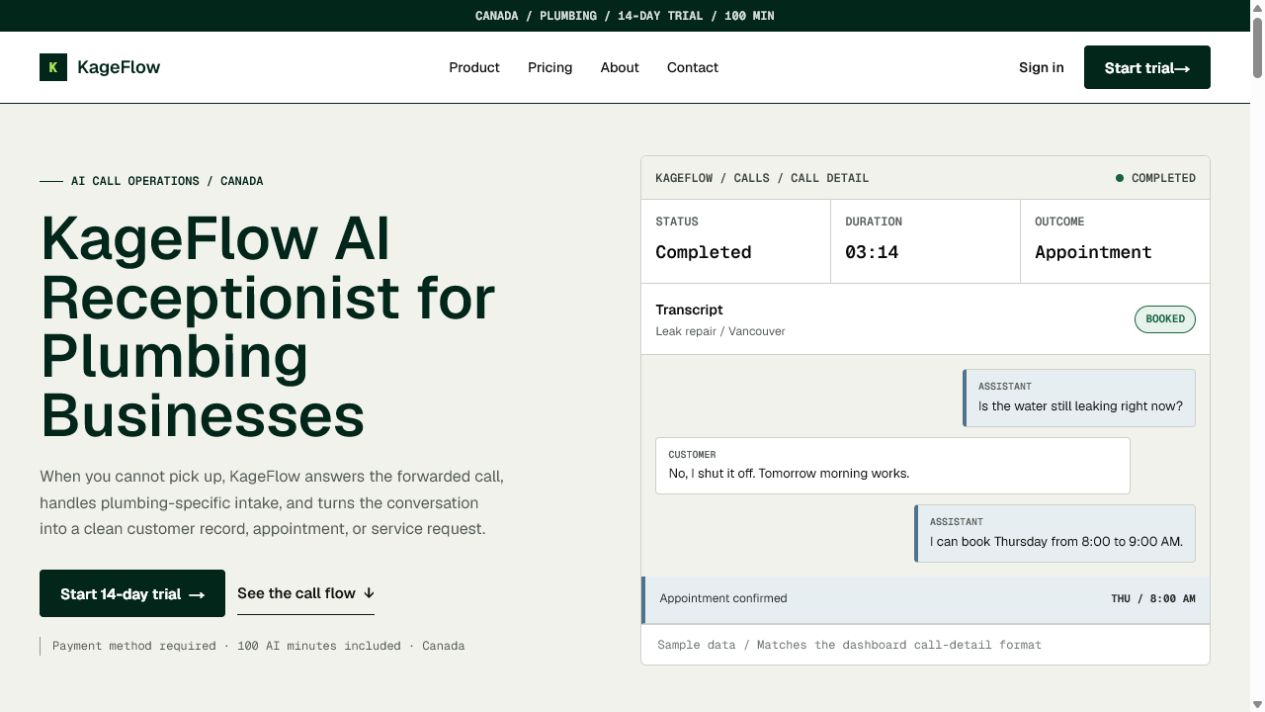
Dashboard
An authenticated operating workspace for phone setup, call records, customers, resource-aware scheduling, services, billing, and receptionist configuration.
- Next.js and React application with server-rendered Supabase authentication and guided activation checks.
- Connected transcripts, customer records, appointments, service requests, and usage controls keep each call outcome actionable.
- Frontend-to-backend proxy boundary keeps privileged credentials outside the browser.
Backend
A typed API and data boundary for multi-tenant business workflows, billing, integrations, and operational readiness.
- Business-scoped authorization and generated PostgreSQL types.
- Stripe Checkout, portal, subscription lifecycle, and signed webhooks.
- Schema-aware readiness checks protect releases from incompatible migrations.
AI Voice
A real-time voice runtime connecting Twilio calls to OpenAI Realtime and controlled business actions.
- WebSocket media transport with business-specific runtime configuration.
- Deterministic tool contracts keep operational changes under backend control.
- Prototype testing reached under 1,000 ms average turn latency and under 600 ms first-token latency.
Marketing
A focused public website for Canadian plumbing businesses that explains the call workflow and hands users cleanly into trial and subscription.
- Responsive product, pricing, about, and contact routes supported by realistic sample dashboard states.
- Cross-origin handoff preserves plan and authentication intent.
- Server-side contact proxy keeps infrastructure boundaries explicit.
Deployment infrastructure
A containerized multi-service topology with immutable images, private networking, release health checks, and rollback.
- GitHub Actions verifies and publishes commit-addressed images to AWS ECR.
- IAM OIDC removes permanent AWS access keys from GitHub.
- EC2, Docker Compose, and Nginx separate public ingress from private service traffic.